

Why you replay conversations and monitor yourself
The conversation is over.
The room is quiet.
But the moment keeps playing.
A sentence you said.
A pause that felt too long.
A look you can’t quite place.
The mind goes back.
Adjusts it.
Re-runs it.
Not because something went wrong —
but because something feels unfinished.
For many people, thinking doesn’t stop when life does.
It watches.
Reviews.
Keeps score.
As if someone, somewhere, is still paying attention.
The Replay Trap
Replaying moments often feels like responsibility.
A way to improve.
A way to avoid future mistakes.
A way to stay socially safe.
The brain scans for:
- What could have landed better
- What might be misunderstood
- What could reflect badly later
At first, this feels careful.
Even intelligent.
But over time, attention turns inward.
Moments aren’t fully lived.
They’re evaluated.
Conversations aren’t experienced.
They’re archived.
And the mind becomes less like a participant —
and more like a quiet observer standing in the back of the room.
What Great Minds and Modern Science Noticed
Long before modern psychology, thinkers noticed this pattern.
The Stoics wrote about the difference between character and reputation.
One is what actually happens.
The other is what might be happening in the minds of others.
They warned that when attention drifts toward the imagined audience, something is lost:
Presence.
From a modern perspective, the brain treats social moments as signals of safety.
Belonging, acceptance, and approval register as security.
Uncertainty, awkwardness, or misunderstanding register as risk.
So when a moment ends without clarity, the system doesn’t “close the file.”
It keeps it open.
It replays.
Rewrites.
Re-runs possibilities.
Not to punish —
but to protect.
Why Awareness Isn’t Enough
Understanding this pattern doesn’t automatically stop it.
Most people can recognize the invisible audience.
Fewer know how to step out of the performance.
Because the habit doesn’t live in thoughts alone.
It lives in the part of the system that decides:
- When it is safe to relax
- When it is safe to stop watching
- When it is safe to let a moment remain unfinished
That system doesn’t respond to insight the way the mind does.
Until it changes, awareness becomes just another thing to monitor.
What Living Under Observation Takes Away
When attention is always turned inward, something subtle happens.
Energy is spent on review instead of experience.
On impression instead of presence.
The world feels slightly distant.
Even in familiar rooms.
Even with familiar people.
Not because connection is missing —
but because the mind is standing between the person and the moment.
Quietly taking notes.
Where This Pattern Is Actually Untangled
In You’re Not Broken — You’re Overwhelmed, this pattern is explored through the lens of ancient thinkers and modern science — not as a flaw to fix, but as a system to understand.
The book doesn’t focus on “thinking better.”
It looks at how the mind learns when it is safe to stop performing.
How awareness becomes something felt, not managed.
And how attention slowly returns to the moment instead of the audience.
This page is the doorway.
The book is the deeper walk inside.
Continue This Line of Thought
The ideas on this page are part of a larger exploration of how the mind learns when it is safe to stop performing — guided by modern science and the wisdom of great thinkers.
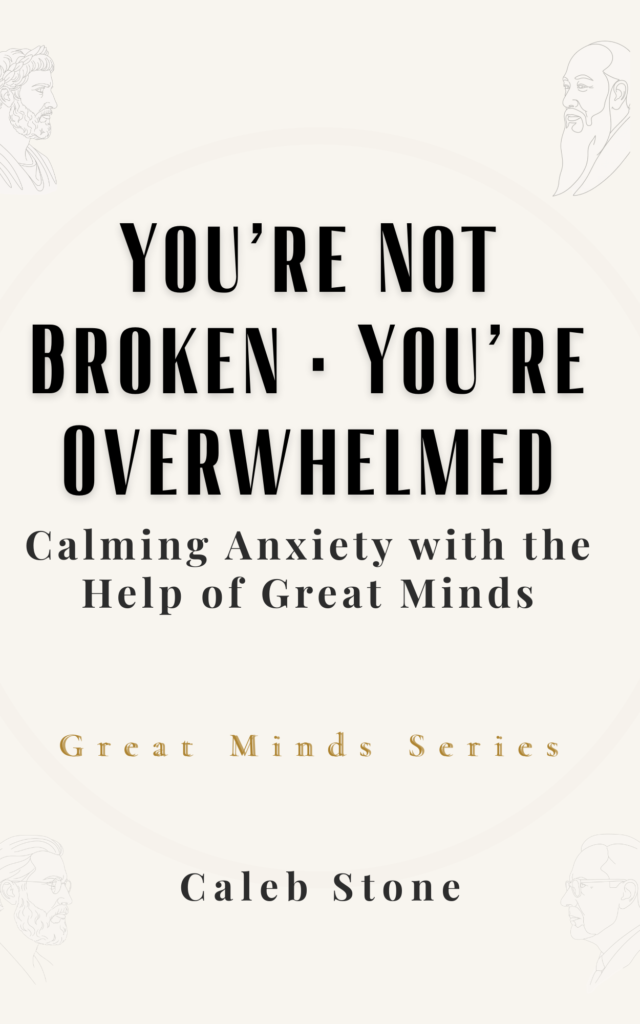
You’re Not Broken — You’re Overwhelmed
A calm, psychology-informed exploration of anxiety as a nervous-system response — guided by modern science and the wisdom of great minds.
Some people prefer to read slowly and privately. If that’s you, you can subscribe here.
Some readers like following along on Facebook for shorter notes between articles.