

WHY YOUR BODY STAYS ON EDGE EVEN WHEN LIFE LOOKS FINE
Anxiety doesn’t always arrive with panic or obvious fear.
Sometimes it settles in quietly — as tension, restlessness, or a constant sense of unease that never fully leaves.
This is often the most confusing kind of anxiety, because nothing appears “wrong.”
Your life may be stable.
You may be functioning.
And yet your nervous system never seems to fully relax.
This experience isn’t a failure of mindset.
It’s a sign of prolonged strain.
WHY ANXIETY ISN’T ALWAYS ABOUT FEAR
We’re often taught to associate anxiety with specific worries:
a looming deadline, a difficult conversation, an uncertain future.
But for many people, anxiety persists even when those worries are handled.
That’s because anxiety isn’t always about what you’re afraid of.
It’s about what your body has learned to anticipate.
Long periods of pressure — emotional, cognitive, or relational — train the nervous system to stay alert.
Not because danger is present, but because it might be.
Over time, vigilance becomes the default.
WHEN THINKING BECOMES A SURVIVAL SKILL
Thinking is usually a strength.
It helps people plan ahead.
Avoid mistakes.
Prepare for conversations.
Stay one step ahead of problems.
Many people who struggle with anxiety aren’t careless or unfocused.
They’re attentive.
They’re trying to get things right.
But when thinking becomes the primary way your nervous system tries to stay safe, it stops serving clarity — and starts reinforcing tension.
Thoughts loop.
Scenarios repeat.
Attention turns inward.
Not to solve something — but to monitor it.
Some thoughts don’t ask for solutions.
They ask for time.
That’s what the Great Minds Series newsletter is —
quiet reflections sent occasionally, without urgency.
(You’re welcome to join if you’d like.)
THE QUIET SHIFT MOST PEOPLE MISS
At some point, thinking changes function.
It’s no longer used to understand the world.
It’s used to watch yourself inside it.
You begin noticing how you’re coming across.
Replaying what you said.
Anticipating how others might respond.
Your mind becomes both the observer and the stage.
This is the shift most people don’t notice — and rarely name.
WHY THE MIND STARTS WATCHING ITSELF
Ancient philosophers noticed this pattern long before modern psychology had language for it.
The Stoics warned that attention, once turned inward excessively, could disturb inner balance.
Modern neuroscience now shows that chronic self-monitoring activates the same stress pathways as external threat.
The mind doesn’t differentiate between danger outside and danger about you.
When attention is constantly self-directed, the nervous system stays engaged — even in quiet moments.
Rest becomes difficult.
Presence feels fleeting.
Stillness feels uncomfortable.
WHY AWARENESS CAN FEEL UNSETTLING INSTEAD OF CALMING
Many people assume that more awareness should bring peace.
But awareness without safety often does the opposite.
If your nervous system is already strained, increased self-focus can amplify discomfort rather than resolve it.
This is why advice like “just notice your thoughts” doesn’t always help.
And why some people feel worse when they try to relax.
The body hasn’t learned yet that it’s allowed to stop performing.
HOW THINKING LOOPS KEEP THE BODY ALERT
When thoughts loop, they send a subtle signal:
Something still needs to be handled.
Even if there’s nothing specific to fix, the body stays prepared.
Muscles hold tension.
Breathing stays shallow.
Attention remains tight.
This isn’t weakness.
It’s conditioning.
Your nervous system is doing exactly what it learned to do.
WHAT ACTUALLY ALLOWS THE MIND TO LET GO
Relief doesn’t come from thinking differently first.
It comes from the body learning that it is safe before thought intervenes.
As safety returns, thinking naturally softens.
Awareness becomes something felt, not managed.
Attention slowly returns to the moment instead of the audience.
This is not a technique.
It’s a relearning process.
WHERE THIS PATH LEADS
The book doesn’t focus on “thinking better.”
It explores how the mind learns when it is safe to stop performing.
How awareness becomes grounding instead of overwhelming.
How attention shifts from self-monitoring to presence.
How calm emerges without force.
This page is the doorway.
The book is the deeper walk inside.
Continue This Line of Thought
The ideas on this page are part of a larger exploration of how the mind learns when it is safe to stop performing — guided by modern science and the wisdom of great thinkers.
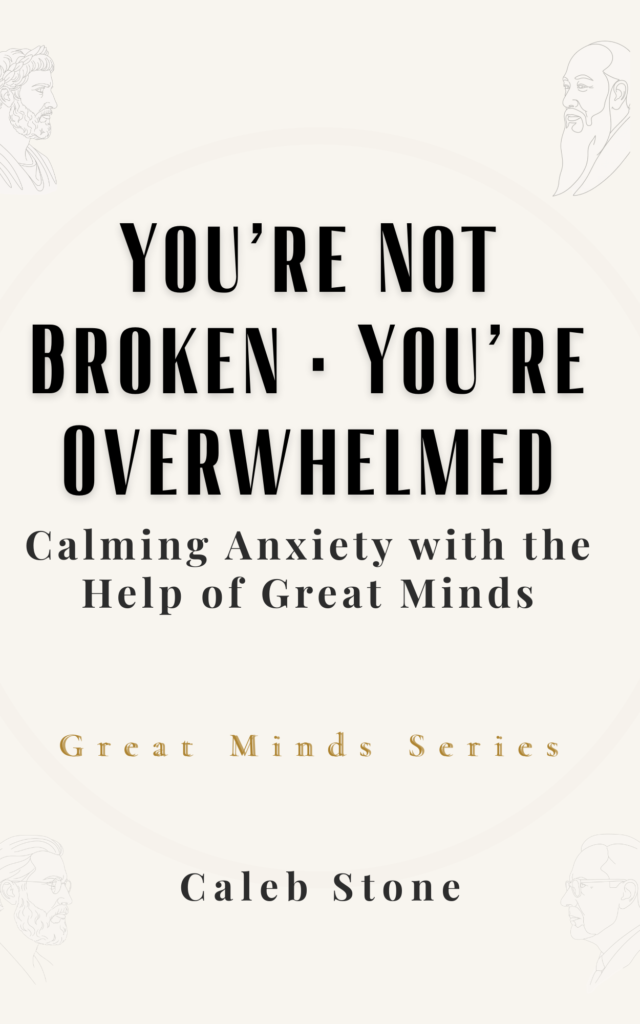
You’re Not Broken — You’re Overwhelmed
A calm, psychology-informed exploration of anxiety as a nervous-system response — guided by modern science and the wisdom of great minds.
If this article stayed with you longer than you expected, this is where it continues.
Some thoughts don’t need more explanation.
They need time.
This is where I write when an article ends
but the reflection doesn’t.
No urgency.
No fixing.
Just quiet notes for people who think deeply
and don’t want to rush past what they’re feeling.
Great Minds Series Newsletter
(sent occasionally, only when there’s something worth saying)
Some readers like following along on Facebook for shorter notes between articles.