

WHEN CALM FEELS UNFAMILIAR, YOUR BODY WON’T TRUST IT
You finally get a quiet moment.
No emergencies.
No conflict.
No deadlines pressing.
And instead of relaxing, your body tightens.
Your mind scans.
Your chest feels alert.
You check your phone.
You look for something to fix.
Nothing is wrong.
So why can’t you relax?
YOUR BODY DOESN’T RESPOND TO LOGIC — IT RESPONDS TO HISTORY
You may know that you’re safe.
But the nervous system doesn’t operate on knowledge. It operates on pattern recognition.
If calm was unpredictable in the past — if quiet moments were followed by tension, criticism, or sudden demands — your system learned something important:
Calm doesn’t last.
So instead of sinking into stillness, your body braces for the shift.
Not because something is happening.
Because something once did.
CALM CAN FEEL LIKE A LOSS OF CONTROL
For people who’ve lived in chronic stress, activity feels safer than stillness.
When you’re moving, planning, fixing, responding — you feel prepared.
When things go quiet, you lose your grip on what’s coming next.
Stillness removes distraction.
And without distraction, unresolved tension becomes noticeable.
That doesn’t mean you’re broken.
It means your nervous system hasn’t associated calm with safety.
Continue This Line of Thought
The ideas on this page are part of a larger exploration of how the mind learns when it is safe to stop performing — guided by modern science and the wisdom of great thinkers.
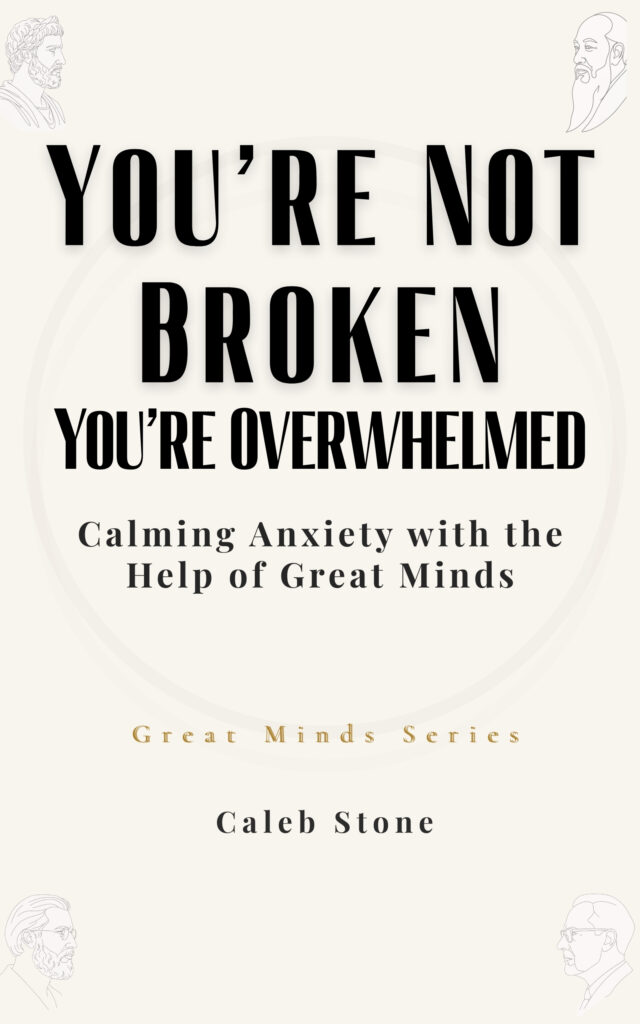
You’re Not Broken — You’re Overwhelmed
A calm, psychology-informed exploration of anxiety as a nervous-system response — guided by modern science and the wisdom of great minds.
HYPERVIGILANCE DOESN’T TURN OFF JUST BECAUSE LIFE IS QUIET
Hypervigilance is subtle.
It looks like:
- Mentally replaying conversations.
- Anticipating future problems.
- Checking for signs of disapproval.
- Preparing for worst-case scenarios.
You may not even notice you’re doing it.
It feels like responsibility.
But it’s actually constant scanning.
And scanning consumes energy.
When nothing external is happening, the scanning becomes more obvious — because there’s nothing to drown it out.
YOUR SYSTEM LEARNED THAT RELAXING WAS RISKY
If you grew up in environments where:
- Conflict appeared suddenly
- Emotional tone shifted quickly
- Expectations changed without warning
- Rest was criticized as laziness
Your body learned a quiet rule:
Stay ready.
Relaxing felt unsafe.
So now, even in objectively calm environments, your body hesitates to power down.
Not because it’s dramatic.
Because it’s protective.
THIS IS WHY VACATIONS DON’T FIX IT
You might take time off.
Sleep more.
Travel.
Reduce responsibilities.
And still feel tense.
That’s because location doesn’t override conditioning.
If safety was never internalized, external quiet doesn’t automatically regulate you.
Your system needs repeated experiences of calm without consequence.
Not a temporary escape.
A new association.
WHY TRYING HARDER TO RELAX MAKES IT WORSE
Telling yourself to relax often creates more tension.
Because now you’re:
- Monitoring your state.
- Judging your inability to settle.
- Forcing something that doesn’t feel natural.
Pressure activates the stress response.
Relaxation doesn’t come from force.
It comes from safety.
And safety grows slowly.
WHAT ACTUALLY HELPS
The shift isn’t dramatic.
It’s gradual.
Instead of asking:
“Why can’t I relax?”
Ask:
“What does my nervous system expect right now?”
Often, it expects interruption.
So you begin showing it something different:
- Quiet that remains quiet.
- Rest that isn’t punished.
- Stillness that doesn’t lead to criticism.
Over time, the body updates.
Not because you argued with it.
Because you gave it evidence.
CONCLUSION
Nothing is wrong.
Your body is simply responding to patterns it once had to survive.
Calm feels uncomfortable when it hasn’t consistently meant safety.
But that doesn’t mean it always has to feel that way.
Safety can be learned.
And when it is, relaxation stops feeling suspicious — and starts feeling normal.
If this article stayed with you longer than you expected, this is where it continues.
Some thoughts don’t need more explanation.
They need time.
This is where I write when an article ends
but the reflection doesn’t.
No urgency.
No fixing.
Just quiet notes for people who think deeply
and don’t want to rush past what they’re feeling.
Great Minds Series Newsletter
(sent occasionally, only when there’s something worth saying)
Some readers like following along on Facebook for shorter notes between articles.