

WHEN YOUR BODY LEARNED TO STAY ALERT
Many people assume their anxiety comes from worrying too much.
They believe the problem is that they think too much, stress too easily, or react too strongly to everyday challenges.
So they try to solve the problem by forcing themselves to relax.
They tell themselves to calm down.
They try breathing exercises, productivity strategies, or positive thinking.
But something strange often happens.
Even when life becomes calmer, their body still feels tense.
Their mind continues scanning.
Their nervous system stays alert.
What many people label as anxiety is sometimes something else entirely.
It may be a nervous system that learned how to survive long periods of stress — and never fully switched back.
YOUR BODY MAY STILL BE OPERATING IN SURVIVAL MODE
The human nervous system is built to protect us.
When it senses danger, it activates survival responses that prepare the body to react quickly.
Heart rate increases.
Attention sharpens.
Muscles tighten.
Energy rises.
These responses are incredibly useful during genuine danger.
But when stressful environments last for long periods of time, the nervous system can adapt in a different way.
Instead of returning to calm after the threat passes, it begins to treat alertness as the new normal.
The body stays ready.
Even when there is nothing immediate to react to.
WHY RELAXING SOMETIMES FEELS DIFFICULT
People often feel confused when relaxation techniques don’t seem to work.
They might sit down to rest, only to notice that their mind continues racing.
Their body may feel restless.
They may even feel slightly uncomfortable during quiet moments.
This doesn’t mean they are doing relaxation wrong.
It may simply mean their nervous system has spent so much time in alert mode that calm now feels unfamiliar.
When the body becomes used to constant stimulation, stillness can feel strange at first.
In some cases, calm environments may even trigger subtle anxiety.
Not because calm is dangerous.
But because the body hasn’t experienced enough of it yet.
Continue This Line of Thought
The ideas on this page are part of a larger exploration of how the mind learns when it is safe and how to learn to feel safe — guided by modern science and the wisdom of great thinkers.
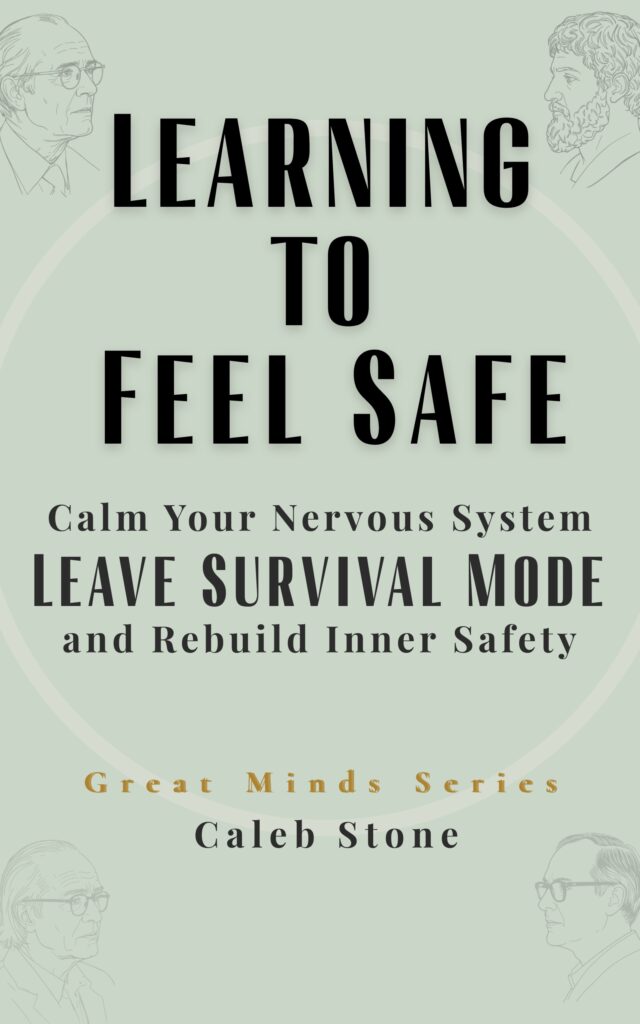
Learning to Feel Safe
For many people, the hardest realization is that their anxiety isn’t simply about worrying too much — it’s about a nervous system that never learned how to fully feel safe. When the body has spent years preparing for stress, calm can feel unfamiliar or even uncomfortable. I explore this idea more deeply in my book Learning to Feel Safe, where I explain why survival mode develops and how people can slowly teach their nervous systems to recognize safety again.
WHEN YOUR MIND STARTS SCANNING FOR PROBLEMS
Another common experience people describe is the feeling that their mind constantly searches for what could go wrong.
They replay conversations.
They anticipate potential problems.
They imagine scenarios that haven’t happened yet.
This pattern is often called overthinking.
But from a biological perspective, it is a form of preparation.
If the brain once needed to anticipate danger in order to stay safe, it may continue doing that long after the environment has changed.
The scanning pattern simply becomes automatic.
WHY REST DOESN’T ALWAYS FIX THE PROBLEM
Many people try to recover from anxiety by resting more.
They take time off work.
They sleep longer.
They try to slow down their schedule.
Sometimes this helps temporarily.
But many people notice that the underlying tension eventually returns.
This happens because rest alone does not retrain a nervous system that has learned to remain alert.
The body needs more than rest.
It needs repeated experiences of safety.
Only through those experiences can the nervous system gradually begin to trust calm again.
LEARNING HOW SAFETY RETURNS
One of the most important things to understand about the nervous system is that it learns through experience.
Just as repeated stress can train the body to remain alert, repeated experiences of safety can gradually retrain it.
This doesn’t happen overnight.
And it rarely happens through logic alone.
The nervous system responds most strongly to consistent signals:
- calm environments
- predictable routines
- supportive relationships
- moments of genuine rest
Over time, these signals can begin teaching the body something it may not have experienced consistently before.
That it is allowed to relax.
THE PROBLEM WAS NEVER THAT YOU WERE “TOO ANXIOUS”
Many people carry quiet frustration with themselves.
They believe they should be able to control their anxiety more easily.
They may feel embarrassed about how strongly their body reacts to stress.
But when survival mode has been active for long periods, those reactions are not signs of weakness.
They are signs of adaptation.
The nervous system simply learned how to protect itself.
Understanding that changes the conversation.
Instead of asking:
“Why am I like this?”
A better question becomes:
“What did my nervous system learn — and how can it learn something new?”
Some people prefer to read slowly and privately. If that’s you, you can subscribe here.
Some readers like following along on Facebook for shorter notes between articles.