

When “Overthinking” Is Actually Your Brain Trying to Protect You
Many people believe their anxiety exists because they think too much.
They assume the problem is that they:
- analyze situations too deeply
- replay conversations repeatedly
- imagine problems before they happen
But for many people, something very different is happening.
Their mind isn’t simply overthinking.
It is watching.
Scanning the environment.
Looking for small signals that something might go wrong.
Not because they want to live this way — but because their brain learned that staying alert once helped them stay safe.
Some Minds Learn Early That Relaxing Isn’t Always Safe
The human brain adapts to the environments it experiences most often.
If someone spends long periods of life dealing with unpredictability, pressure, or emotional stress, the brain slowly learns something important:
It becomes skilled at anticipating problems before they appear.
This ability can develop in many situations:
- unstable environments
- difficult relationships
- constant responsibility
- years of needing to stay prepared for the next challenge
Over time the brain becomes very good at detecting small changes.
A shift in tone.
A subtle signal in someone’s behavior.
A possibility that something might go wrong.
What looks like overthinking is often something else entirely.
It is a brain that learned its job was protection.
Why Calm Can Feel Strange When Your Brain Is Used to Stress
One of the most confusing experiences for people in this situation is what happens when life finally becomes calmer.
You might expect the mind to relax.
Instead, many people experience something surprising.
Calm feels uncomfortable.
When the environment becomes quiet, the brain sometimes asks questions like:
“What problem am I missing?”
“What should I be preparing for?”
“Why does this feel too peaceful?”
This doesn’t happen because someone enjoys stress.
It happens because the nervous system spent years learning that anticipating danger prevented pain.
When stress disappears, the brain sometimes continues searching for it.
Signs Your Brain Is Always Scanning for Possible Problems
Many people recognize themselves in patterns like these:
• replaying conversations long after they happen
• imagining what could go wrong in situations that haven’t happened yet
• struggling to relax even when life is calm
• preparing for worst-case scenarios automatically
• feeling responsible for preventing future problems
To someone observing from the outside, this behavior may look like unnecessary worrying.
But internally it often feels like something different.
It feels like the mind is simply trying to stay prepared.
A Brain That Learned Survival Becomes Very Good at It
The brain is not designed to eliminate danger.
It is designed to detect it early.
If someone spends enough time navigating stressful or unpredictable situations, the brain strengthens the systems responsible for alertness.
It becomes faster at recognizing patterns.
Better at anticipating risks.
More sensitive to subtle changes in the environment.
These abilities once served an important purpose.
They helped the person adapt and protect themselves.
But long after the environment changes, the brain may continue using the same strategy.
It keeps scanning.
Not because something is wrong.
But because it learned that staying alert was the safest way to live.
Why Overthinking Is Often a Nervous System Pattern
Many people try to solve overthinking with logic.
They tell themselves:
“There is nothing to worry about.”
“I should relax.”
“Everything is fine.”
But the nervous system does not respond instantly to logical explanations.
It responds to patterns that have been repeated over time.
If the body spent years learning that stress was normal, calm can feel unfamiliar.
The nervous system needs time to recognize that life has changed.
This is why many people understand intellectually that they are safe, yet still feel internally tense or alert.
Their mind understands the present.
But their nervous system is still responding to the past.
The Part Most People Don’t Realize About Feeling Safe
Feeling safe is not just a thought.
It is a physical experience inside the nervous system.
The body has to slowly learn that it no longer needs to stay on guard all the time.
That process rarely happens overnight.
It happens gradually as the brain begins experiencing moments of calm that repeat often enough to become believable.
This idea is explored deeply in the book Learning to Feel Safe, which explains how the nervous system adapts to long periods of stress — and how it can gradually learn to relax again.
Many people discover that understanding this process changes the way they view their own mind.
Instead of seeing overthinking as a personal flaw, they begin recognizing it as a pattern the brain once used to survive.
Continue This Line of Thought
The ideas on this page are part of a larger exploration of how the mind learns when it is safe and how to learn to feel safe — guided by modern science and the wisdom of great thinkers.
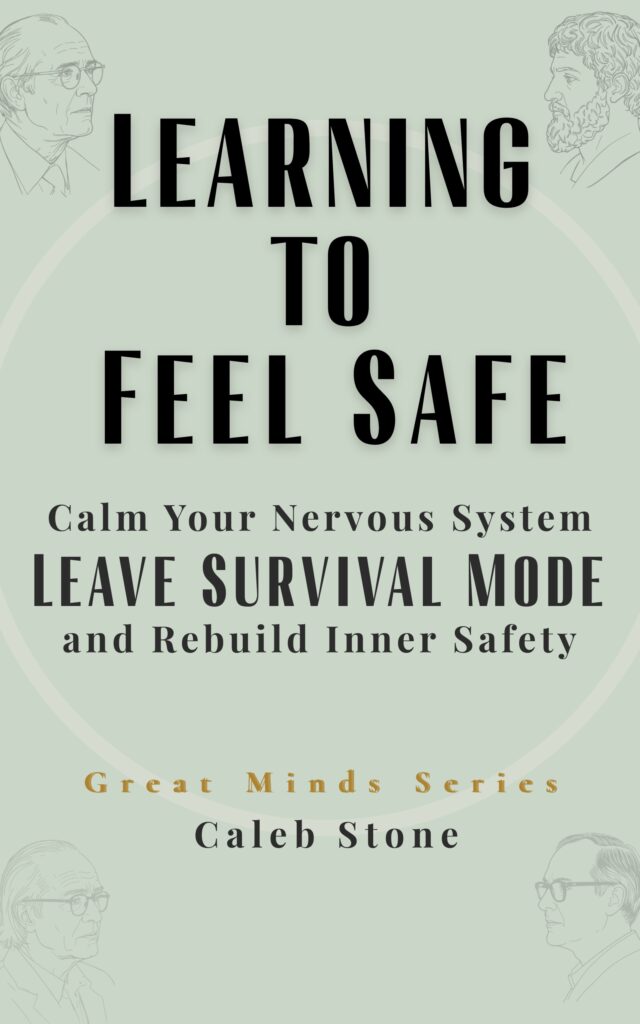
Learning to Feel Safe
For many people, the hardest realization is that their anxiety isn’t simply about worrying too much — it’s about a nervous system that never learned how to fully feel safe. When the body has spent years preparing for stress, calm can feel unfamiliar or even uncomfortable. I explore this idea more deeply in my book Learning to Feel Safe, where I explain why survival mode develops and how people can slowly teach their nervous systems to recognize safety again.
Teaching the Nervous System That It No Longer Has to Stand Guard
When the brain has spent years preparing for danger, learning safety becomes a slow process.
It involves small shifts rather than dramatic changes.
Moments where the body experiences calm and begins to recognize that nothing bad follows.
Over time these experiences allow the nervous system to update itself.
The mind begins to understand that it does not need to analyze every situation.
That constant scanning is no longer required.
Safety becomes something the body can experience rather than something the mind has to constantly search for.
Your Mind May Not Be Broken — It May Be Well Trained
Many people criticize themselves for thinking too much.
They assume something is wrong with the way their brain works.
But in many cases the opposite is true.
Their brain became extremely good at detecting potential danger.
It learned how to protect them.
The goal now is not to fight that instinct.
It is to help the nervous system learn something new.
That the world is not always unpredictable.
That calm can exist.
And that the mind does not always have to stay on guard.
Sometimes the mind that struggles to relax is simply the mind that once learned survival.
And learning safety again is a process that takes patience — but it is possible.
Some people prefer to read slowly and privately. If that’s you, you can subscribe here.
Some readers like following along on Facebook for shorter notes between articles.