

WHY YOUR BODY STAYS ON EDGE EVEN WHEN LIFE IS CALM
Many people live with a constant sense of tension they can’t explain.
Their shoulders never fully drop.
Their breathing feels shallow.
Their mind stays alert, even during quiet moments.
Nothing is technically “wrong,” yet the body behaves as if danger is nearby.
This isn’t weakness. It’s a nervous system that learned to survive — and hasn’t been given enough evidence that it can stand down.
WHAT “SURVIVAL MODE” ACTUALLY MEANS
Survival mode refers to the body’s automatic stress responses: fight, flight, freeze, and collapse.
These responses exist to protect you. They activate without permission, faster than thought, and independently of logic.
When the nervous system detects threat — emotional or physical — it prioritizes protection over comfort. Heart rate increases. Muscles tense. Attention narrows.
This system is not designed for short bursts only. When stress becomes prolonged, survival mode can become the default state.
HOW A NERVOUS SYSTEM GETS STUCK
A nervous system gets stuck in survival mode when stress is chronic and unresolved.
This doesn’t require trauma in the dramatic sense. It often comes from:
- Long periods of emotional unpredictability
- Feeling responsible for too much
- Never fully feeling safe enough to relax
- Repeatedly pushing through exhaustion
Over time, the body stops waiting for relief. It learns that vigilance is necessary.
WHY YOUR BODY DOESN’T FOLLOW LOGIC
You may know you’re safe.
But the nervous system doesn’t operate on logic — it operates on pattern recognition.
If past experience taught your body that calm moments were temporary or unreliable, it won’t trust reassurance. Safety has to be felt, not explained.
This is why telling yourself to “relax” often increases frustration instead of calm.
HOW SURVIVAL MODE SHOWS UP DAY TO DAY
Living in survival mode can look subtle:
- Constant alertness
- Difficulty resting deeply
- Irritability or emotional reactivity
- Fatigue that doesn’t resolve with sleep
These aren’t personality traits. They’re physiological states.
WHAT SIGNALS SAFETY TO THE NERVOUS SYSTEM
The nervous system responds to consistency, predictability, and gentle input.
Safety is signaled through:
- Slow, steady rhythms
- Reduced urgency
- Familiar routines
- Non-demanding presence
The system needs repeated evidence that nothing is required of it in that moment.
CONCLUSION
Your nervous system isn’t broken.
It adapted to survive. And with patience, it can learn safety again.
Continue This Line of Thought
The ideas on this page are part of a larger exploration of how the mind learns when it is safe to stop performing — guided by modern science and the wisdom of great thinkers.
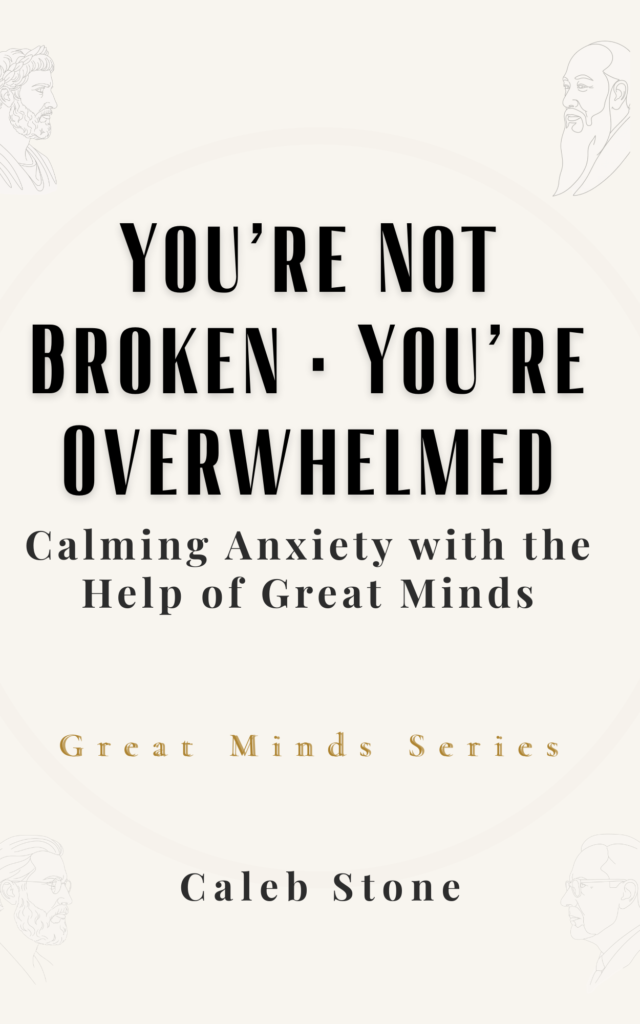
You’re Not Broken — You’re Overwhelmed
A calm, psychology-informed exploration of anxiety as a nervous-system response — guided by modern science and the wisdom of great minds.
If this article stayed with you longer than you expected, this is where it continues.
Some thoughts don’t need more explanation.
They need time.
This is where I write when an article ends
but the reflection doesn’t.
No urgency.
No fixing.
Just quiet notes for people who think deeply
and don’t want to rush past what they’re feeling.
Great Minds Series Newsletter
(sent occasionally, only when there’s something worth saying)
Some readers like following along on Facebook for shorter notes between articles.