

When Life Looks Fine but Your Body Disagrees
From the outside, everything seems fine. There is no immediate problem, no urgent situation demanding your attention. Life, at least on the surface, appears calm.
And yet, inside, something doesn’t match that reality.
Your body feels tense. Your mind stays alert. Relaxation doesn’t come as easily as it should. Even in quiet moments, there is a subtle sense that something isn’t settled.
Many people in this position ask themselves the same question:
Why can’t I just relax when nothing is wrong?
What makes this experience so frustrating is that there is no clear answer in the present moment.
When the Body Learns to Stay Ready
The nervous system does not operate based on what should be happening. It operates based on what it has learned over time.
If someone spends long periods of life dealing with stress, unpredictability, or emotional pressure, the body adapts in a very specific way. It becomes faster, more alert, more prepared.
It learns to stay ready.
This readiness is not a conscious decision. It is a pattern built through repetition. The nervous system begins to assume that being prepared at all times is the safest way to exist.
Even when life eventually becomes calmer, that pattern does not disappear overnight. The body continues responding the way it was trained.
Not because something is wrong.
Because it learned that staying ready once mattered.
Why Relaxing Can Feel Unnatural
For many people, relaxation is not just difficult — it feels unfamiliar.
When things finally slow down, instead of relief, there is discomfort. The mind begins to search for something to focus on, something to solve, something to anticipate.
Questions appear almost automatically:
What am I missing?
Why does this feel too quiet?
Is something about to happen?
This reaction is often misunderstood as overthinking. But it is usually something deeper.
It is a nervous system that does not yet trust calm.
Signs Your Body Is Still in Survival Mode
You might recognize this pattern in small, everyday ways.
You sit down to relax, but your mind immediately jumps ahead to what needs to be done next. You replay conversations, wondering if you missed something important. Even in peaceful moments, there is a background sense of tension.
You may notice that you feel more comfortable being busy than being still.
From the outside, this can look like overthinking or restlessness. Internally, it feels like your system is simply trying to stay one step ahead.
As if staying prepared is the only way to stay safe.
Continue This Line of Thought
The ideas on this page are part of a larger exploration of how the mind learns when it is safe and how to learn to feel safe — guided by modern science and the wisdom of great thinkers.
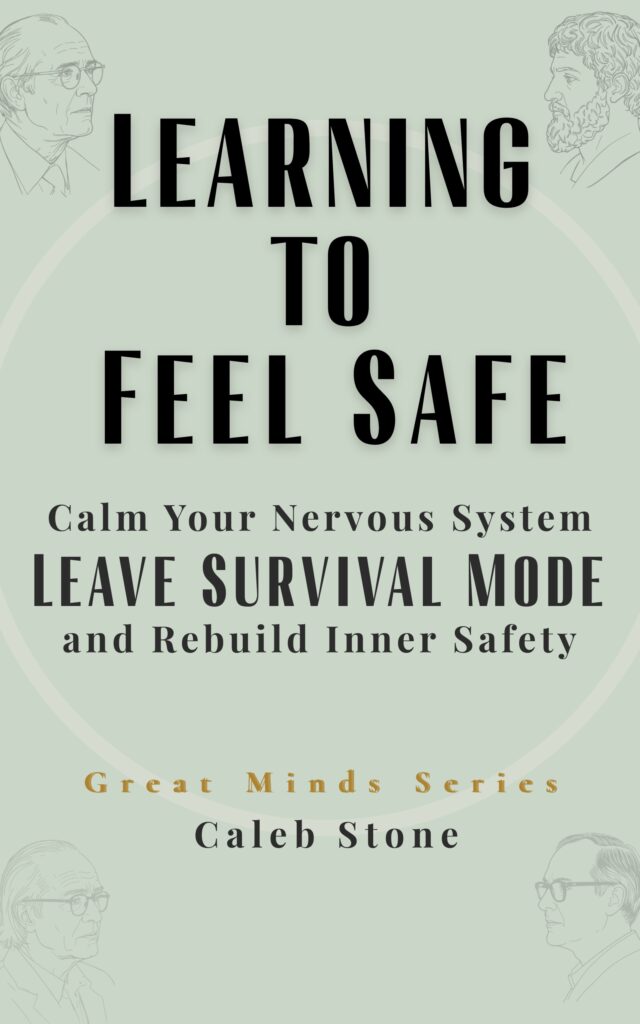
Learning to Feel Safe
For many people, the hardest realization is that their anxiety isn’t simply about worrying too much — it’s about a nervous system that never learned how to fully feel safe. When the body has spent years preparing for stress, calm can feel unfamiliar or even uncomfortable. I explore this idea more deeply in my book Learning to Feel Safe, where I explain why survival mode develops and how people can slowly teach their nervous systems to recognize safety again.
Why Your Mind Keeps Looking for a Problem
The brain is designed to predict and prevent. Its job is to scan for potential issues before they become real problems.
When that system has been used frequently over time, it becomes very efficient.
Even when there is no clear issue, the mind continues searching. It tries to fill the silence with something to analyze, something to prepare for.
This is why calm moments can feel the most mentally active.
The brain is not reacting to danger.
It is trying to make sure danger does not appear.
Logic Doesn’t Always Reach the Nervous System
Many people try to solve this by reasoning with themselves.
They remind themselves that everything is fine. They try to force relaxation. They tell themselves to stop overthinking.
But the nervous system does not respond quickly to logic.
It responds to patterns.
If the body has spent years learning that stress is normal, it will not immediately believe that calm is safe. The mind may understand the present situation clearly, but the body is still responding to past experience.
This disconnect is what makes the experience so confusing.y experiences safety again — not when anxiety is argued away.
Feeling Safe Is Something the Body Has to Learn
Safety is often misunderstood as a thought. Something you convince yourself of.
In reality, safety is something the body experiences.
It shows up gradually — in the way your breathing slows, in the way tension begins to release, in the absence of urgency.
These shifts don’t happen all at once. They happen through repeated experiences where nothing goes wrong, where calm remains calm.
Over time, the nervous system begins to recognize that it no longer needs to stay in constant alert mode.
The Shift Most People Are Missing
The goal is not to force your mind to stop thinking.
The goal is to help your nervous system learn something new.
That calm does not need to be questioned. That stillness is not a warning sign. That the absence of problems does not mean something is about to happen.
This shift happens gradually, through awareness and repetition.
These ideas are explored in the book Learning to Feel Safe, which explains how the nervous system adapts to long periods of stress — and how it can slowly relearn what calm actually feels like.
For many people, understanding this is the moment things begin to make sense.
You’re Not Failing — Your System Is Still Protecting You
When relaxation feels difficult, it is easy to assume something is wrong with you.
That you should be calmer. More in control. Less reactive.
But in many cases, your system is doing exactly what it was designed to do.
Protect.
Prepare.
Stay ready.
Those patterns were learned for a reason.
The goal now is not to eliminate them, but to help your system recognize that it does not always need to rely on them.
Nothing Is Wrong — Your Body Just Hasn’t Learned That Yet
For many people, the most important realization is this:
The feeling of being on edge does not always mean something is wrong.
Sometimes it simply means your body is still responding to patterns it learned in the past.
And those patterns can change.
The mind can quiet.
The body can relax.
And safety can become something you don’t just understand — but actually feel.
Some people prefer to read slowly and privately. If that’s you, you can subscribe here.
Some readers like following along on Facebook for shorter notes between articles.