

When Connection Feels Close… But Not Fully Safe
Some people don’t struggle with meeting others.
They can talk, laugh, connect, and even build relationships.
From the outside, everything looks normal.
But internally, something stays held back.
There’s a line that never fully disappears.
A quiet distance.
Not enough to break the relationship — but enough to keep it from becoming completely open.
Many people don’t notice this pattern at first.
They just feel like they are “careful” with people.
You’re Not Avoiding People — You’re Managing Risk
This pattern is often misunderstood.
It’s easy to assume someone is distant, uninterested, or emotionally unavailable.
But in many cases, something more specific is happening.
They are not avoiding connection.
They are controlling how much of themselves is exposed.
They share, but not everything.
They open up, but only to a certain point.
They stay present, but still protected.
This isn’t rejection.
It’s risk management.
When Openness Once Led to Discomfort
The mind doesn’t randomly decide to hold back.
It learns.
At some point, openness may have felt uncomfortable, overwhelming, or unsafe.
That doesn’t always mean something extreme happened.
Sometimes it’s subtle:
- being misunderstood
- feeling dismissed
- emotional needs not fully met
- learning to handle things alone
Over time, the brain begins to associate openness with uncertainty.
And uncertainty becomes something to control.
Signs You Let People Close — But Not Too Close
Many people recognize this pattern when they look closely.
• you share, but avoid the deeper parts
• you prefer handling things on your own
• vulnerability feels unnatural or uncomfortable
• you feel connected, but still slightly separate
• people see parts of you — but not everything
From the outside, this looks like independence.
Internally, it can feel like something is always being held back.
Continue This Line of Thought
The ideas on this page are part of a larger exploration of how the mind learns when it is safe to stop performing — guided by modern science and the wisdom of great thinkers.
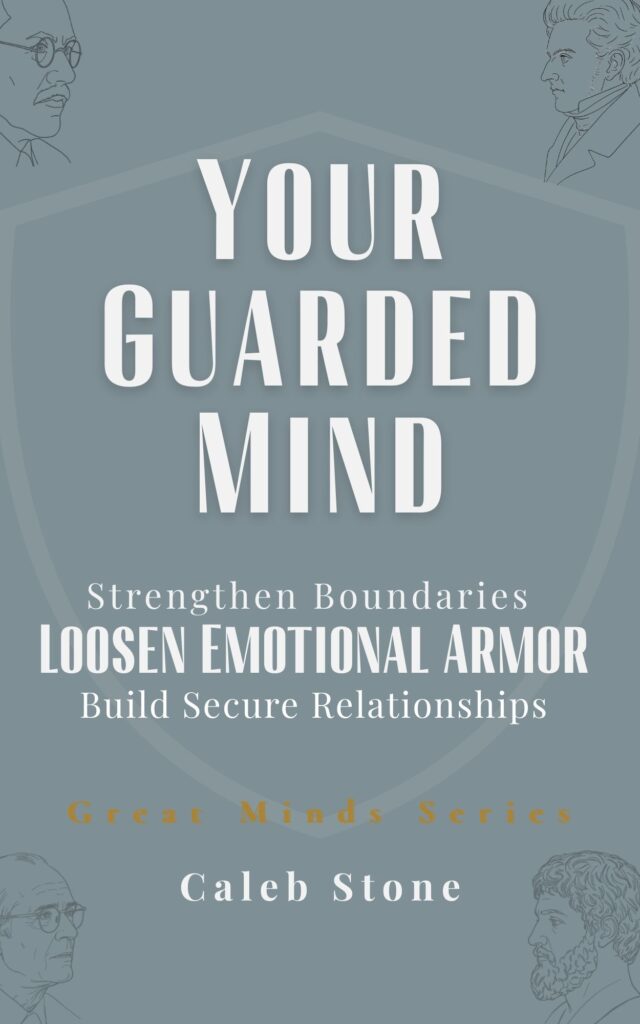
Your Guarded Mind
A Guide to Emotional Healing, Setting Boundaries, and Building Secure Relationships (Great Minds Series)
Why This Pattern Feels So Normal
One of the reasons this is difficult to recognize is because it works.
It protects.
It keeps relationships stable.
It avoids emotional risk.
You don’t get hurt easily.
You don’t depend too much.
You don’t expose yourself completely.
But there’s a tradeoff.
Real connection requires a level of openness that this pattern quietly limits.
The Line Between Safety and Distance
This is where the pattern becomes important to understand.
There is a difference between:
Healthy boundaries
and
emotional guarding
Healthy boundaries allow connection while protecting well-being.
Guarding creates distance while appearing like connection.
The difference is subtle.
But it changes everything.
Why Letting People In Feels Uncomfortable
For someone used to staying guarded, deeper openness doesn’t feel natural.
It can feel:
- unfamiliar
- risky
- unnecessary
- even slightly unsafe
The mind begins asking questions:
“What if I’m misunderstood?”
“What if this changes things?”
“What if I lose control of the situation?”
These reactions are not random.
They are learned.
The Part Most People Don’t See About Being “Guarded”
Many people think being guarded is a personality trait.
But often, it’s a pattern the brain developed to maintain emotional control.
It keeps things predictable.
It avoids situations where someone feels exposed.
It allows connection — but only within safe limits.
The problem is that those limits don’t always adjust automatically.
Even when someone wants deeper connection, the pattern remains.
Why This Isn’t About “Fixing” Yourself
People often approach this pattern by trying to force themselves to open up more.
To be more vulnerable.
To “just trust people.”
But this rarely works.
Because the pattern isn’t about choice alone.
It’s about how the mind learned to associate openness with risk.
Until that association changes, forcing vulnerability can feel unnatural.
Learning How to Let People In Without Losing Yourself
The real shift isn’t about removing boundaries.
It’s about understanding the difference between protection and disconnection.
It’s about allowing connection to expand gradually, without forcing it.
And it’s about recognizing that openness doesn’t have to mean losing control.
These ideas are explored in Your Guarded Mind, which looks at how emotional patterns form in relationships and how people can begin to create deeper, more secure connections without feeling overwhelmed.
For many people, understanding this pattern is the first time they realize:
They weren’t pushing people away.
They were simply trying to stay safe.
You Don’t Push People Away — You Just Learned to Stay Protected
The mind that holds back is not broken.
It’s careful.
It’s observant.
It learned to protect something important.
But protection doesn’t have to mean distance forever.
Over time, the mind can learn that connection doesn’t have to come with the same level of risk.
That being understood is possible.
That letting someone in doesn’t mean losing yourself.
And that the line between safety and connection can slowly begin to shift.
Some people prefer to read slowly and privately. If that’s you, you can subscribe here.
Some readers like following along on Facebook for shorter notes between articles.